Dad’s Pickles

Picture of pickles

As a kid, I grew up with an abundance of home-made pickles, preserves, jams, marmalades, curds and chutneys.

In my parent’s country of origin (Britain), pickles are an institution.

Virtually all cultures have developed processes for food preservation.

Indians have spicy chutneys; Spanish have salsas and Europeans have glazed fruits.

Most of the techniques where developed prior to refrigeration, in an attempt to slow down food spoilage and allow fruit and vegetables to be stored for longer, because once fresh produce is harvested it very quickly deteriorates.

Furthermore, due to climatic conditions some produce weren’t available again until the seasons turned full circle.

With modern day availability of year-round fresh produce and advanced refrigeration technology, it could be argued that the preservation techniques of old are now obsolete.

Besides, you can also buy mass produces preserves. 

The problem with that argument is that home-made preserves just taste so much better than factory-made. 

My Dad recently gave me a jar of his amazing pickled onions, the best I’ve ever eaten.

Unfortunately, he hasn’t quite shared the recipe with me, but in my next blog I’ll share my own personal recipe with you, possibly not as good as Dad’s pickles – but close.
Posted in Food and Cooking | Tagged , , , , , , , | Leave a comment

The Perfect Steak

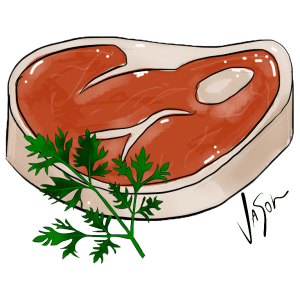
Picture of Steak

As I promised, here’s some brief advice on how to achieve the perfect steak:

  1. Don’t cook a cold steak. Take it out of the fridge 20 minutes before cooking to remove some of the chill. You are more likely to achieve the right degree of cooking if the steak is closer to room temperature to begin with, but always consider hygiene.
  2. The steak must be placed on a very hot surface (pan or grill) that begins to sizzle immediately on contact. If the heat is too low, the steak will not hold in its juices and will begin to stew.
  3. Before cooking, brush the steak with olive oil and season with sea salt flakes and freshly milled black pepper, this will enhance the flavour.
  4. Seal the steak for at least one minute on each side, the remaining cooking time will depend on how far you want the steak to be cooked. If a steak is really thick, you may have to adjust the temperature down during the cooking process.
  5. Allow the cooked steak, to rest for approximately half the amount of time it took to cook, before serving. This will let the muscle fibers relax and become tenderer
Posted in Food and Cooking | Tagged , , , , | Leave a comment

There’s No Such Thing As Medium-Well

Picture of steak with cross

I’ve had customers describe the degree they’d like their steaks cooked in countless ways, including ‘Still Mooing’ and ‘Cremated’.

I’ll always oblige the request of a customer, because the customer pays my wage.

However, there are some widely held misconceptions about the ‘degree of doneness’ in steaks.

To start with, the red liquid that flows from a cooking steak is ‘sarcoplasm’ (not blood), and the pink colour of cooked meat is the remaining pigmentation.

Blood is drained from the animal at slaughter, and any residual blood coagulates during storage or the early stages of cooking.

It’s a simple fact that the only way to remove the pink colour is to cook the steak long enough to render out all the juicy fat, contracting the muscle fibre so tightly that any remaining moisture takes the colour with it.

Obviously this leaves you with a grey coloured steak as tough and dry as a worn out shoe. 

The truth is that you only really have the option of raw, rare, medium or well-done. You can’t have a well-done steak which is still juicy.

Sorry to say it, but if you ask for medium-well (no pink, but still juicy), the chef will often play it safe and just give you well-done anyway.

Posted in Food and Cooking | Tagged , , , , , , | 3 Comments

The Bachelor’s Food Guide

Picture of tuxedo with knife and fork

CANNED GOODS: Any canned goods that have bloated to the size or shape of a cricket ball should be disposed of – very carefully!

CARROTS: A carrot that you can tie in a knot in is not fresh.

DIPS: If you can take it out of its container and bounce it on the floor, it has gone bad.

DAIRY: Milk is spoiled when it starts to look like yoghurt. Yoghurt is spoiled when it starts to look like cottage cheese. Cottage cheese is spoiled when it starts to look like regular cheese. Regular cheese is nothing but spoiled milk anyway and can’t get any more spoiled than it is already.

EGGS: When something starts pecking its way out of the shell, the egg is probably past its prime.

FLOUR: Flour is spoiled when it begins to move.

GAG TEST: Anything that makes you gag is spoiled (except for your own cooking).

LETTUCE: Lettuce is spoiled when you can’t get it off the bottom of the vegetable crisper without sandpaper.

MAYONNAISE: If your internal organs shut down after you eat it, the mayonnaise is spoiled.

MEAT: If opening the refrigerator door causes all stray animals within a three-block radius to congregate outside your house, the meat is spoiled.

POTATOES: Fresh potatoes do not have roots, branches, or dense, leafy undergrowth.

SALT: Salt never spoils.

RULE OF THUMB: Most food cannot be kept longer than the average life span of a guinea pig. Keep a guinea pig in or near your refrigerator as a gauge

Posted in Food and Cooking | Tagged , , , , | Leave a comment

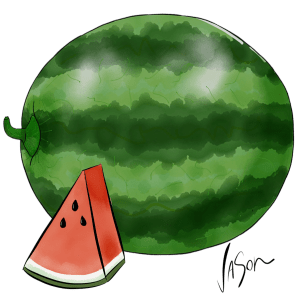
The Great Watermelon Heist

Picture of WatermelonWhen I was a youngster, I swiped a watermelon from a neighbour’s property.
I stealthily crawled under the barbed wire behind his chicken shed, and with military precision pinched the biggest melon I could roll back to my yard.

With great difficulty, I hoisted the melon into my tree house and greedily ate my prize.

This was soon followed by a monster belly ache from Hell, and the following day my neighbour warned me that if he ever saw me pilfer one of his melons again, he’d set the dogs on me.

Obviously, Watermelons are from the melon family. They are grown in both tropical and subtropical climates.

The biggest producers are China, Turkey, Iran, Brazil and parts of the US.

Watermelon is often a large round or oval shape, with dark green skin and deep-pink flesh and black seeds.

However, some varieties have pale green skin, some have yellow or white flesh, and many contemporary varieties are seedless.

The texture should be firm and very juicy, as per its namesake and the flesh should be sweet and perfumed in flavour.

Watermelon can be eaten on its own, made into frozen sorbet, used in tropical salads. I’ve even seen it grilled on a barbecue.

Posted in Food and Cooking | Tagged , , , , , | Leave a comment

The Alfalfa Experiment

Picture of alfalfa

I’ve learnt heaps from my kids various science experiments.

My daughter once grew alfalfa. The instructions on the pack of seeds read “Grow your own edible natural sprouts in just 3-6 days”.

The seeds went in jar with a little water and covered with cloth. Much like a Harry Potter spell, hey presto we were eating alfalfa four days later.

The only home science experiment I ever conducted as a child was to hide my uneaten school lunch under my bed.

A week later, a Jurassic forest of fuzzy mould and an entire civilization of creepy crawlies had spawned. At least my daughter’s alfalfa was edible. 

Alfalfa is the immature sprouts of a perennial clover-like plant from the pea family.

The sprouts are a highly nutritious ingredient, and I reckon they have a pleasant, nutty flavour. 

However, a lot of people consider them rabbit food. Ironically, I once saw a box of alfalfa seeds in a pet shop with a picture of a rabbit on the front.

The plant is often cultivated until mature and sold as Lucerne cattle feed. 

But, if you’re in the mood for some healthy sprouts, here are some ways I’ve seen alfalfa used:

  • Baked in bread with pumpkin seeds.
  • Made into a salad with radish and mandarin.
  • Juiced with carrot, just wrap the sprouts in a lettuce leaf and send through the electric juicer along with carrot.
  • On a sour dough sandwich with fresh sand crab and chili mayonnaise.
  • In a mountain bread wrap with roast beef and horseradish cream.
Posted in Food and Cooking | Tagged , , , , , | Leave a comment

Eat Your Grits

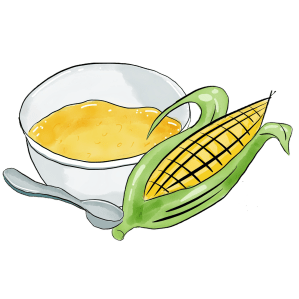
Picture of polenta in bowl with corn cobb and spoon

Polenta is made from finely ground cornmeal (dried corn) and is similar to the courser dish Americans refer to as ‘Grits’.

It can be purchased in either a yellow or white colour.

When slowly cooked in a liquid, such as water, cornmeal becomes a thick porridge-like mixture called polenta.

Polenta makes an interesting and healthy substitute for mashed potato or steamed rice.

I personally love eating polenta with grilled sausages, or a hearty stews.

Cheesy Polenta

  1. Bring 1Lt of milk to the boil. Gradually sprinkle in 180g of polenta, while whisking constantly.
  2. Reduce the heat and gently simmer, while stirring for approximately 5 minutes.
  3. When the mixture has thickened to a smooth consistency, add 40g of butter, 100g grated parmesan and season with salt and white pepper.
  4. Stir until all the ingredients are combined.

Note: You can use a combination of milk and/or chicken stock for a more savoury finish. Additional fresh herbs, such as parsley or chives can also be added for flavour. After refrigeration, polenta becomes firm enough to cut into slices, which can then be pan-fried.

Posted in Food and Cooking | Tagged , , , , | Leave a comment

Eat With Your Eyes

Picture of eye with knife and fork

People eat with their eyes first.

As a chef, I won’t get a second opportunity to make a first impression.

A badly presented meal will set the mood for the rest of the customer’s dining experience.

When I’m invited to dinner by friends, they often apologies for the way they’ve presented their meals.

Personally, I’m just happy someone’s doing the cooking instead of me.

Great food presentation is a skill that can take many years to master, but following some simple guidelines can make a difference.

It doesn’t involve creating a pretentious looking monument on each plate. Aim to present the food to the best of its potential.

Colour balance is essential; don’t place identical coloured vegetables side-by-side on the plate. Steamed carrots would look more effective next to green broccoli, rather than roast pumpkin and sweet potato.

Elevating the food higher, by propping it up or stacking it looks far more appealing than a flat, dead looking meal.

Keep the meal inside the outer rim of the plate; imagine the rim of the plate as a picture frame. An artist would rarely paint their landscape off the canvas and onto the frame.

Carefully consider your choice of crockery; a large meal on a small plate looks busy and cluttered.

A clean and simply presented meal within the centre of an appropriate plate looks much more appetising.

And remember, a great drop of wine will compliment your meal, or at least distract everybody from any mistakes on the plate.

Posted in Food and Cooking | Tagged , , , , | Leave a comment

The Breakfast Club

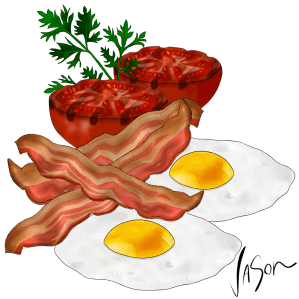
Picture of bacon and eggsIf you love a good breakfast… then join the club.

For two thirds of the year, my family and I spend brekky time out on the verandah in the fresh morning air.

Sometimes, I even crank up the barbecue to cook our bacon and eggs. Although I usually look for healthy options, I just worship an indulgent breakfast.

So, what kinds of breakfast menus are there?

Here are some popular choices:

Full Breakfast – was made popular by the English, and has a lot of traditional cooked fair like eggs, meats, small goods (bacon), sausages, mushrooms, fish (kippers), pastries, toast and conserves and hot beverages like coffee. That’s what I’m talk’n ‘bout!

Continental – is a lighter European or French option, with tea and coffee being the important part, accompanied by cereal, fruit juice and small baked pastry items (Danish pastries). Probably the best choice if you’re feeling a little seedy.

American­ – hash brown always come to mind, as well as pancakes, waffles, crepes and French toast. The whole lot is usually smothered in whipped butter and maple syrup. Mostly sweet stuff really.

Chicken and Champagne
 – usually reserved for special events like horse races (Melbourne Cup), the opening of festivals and during an early morning hot air balloon or boat ride.

Asian ­– ‘Congee’ is a special creamed rice and bean curd porridge, accompanied by fresh fruits and Asian style teas. Now becoming trendy in Australia and other western countries.

Cowboy – Bacon, lard, beans and whisky. Only joking, I just made that one up.

Posted in Food and Cooking | Tagged , , , , , , | Leave a comment

Lack Culture? Eat Yoghurt!

Illustration of yoghurtSomebody once told me, “Jason…the closest you’ll ever get to culture, is yoghurt”.

Pretty harsh comment really, but I think I deserved it at the time.

It comes as a surprise to some people that less than one percent of all bacteria on earth are dangerous to humans.

The ones that cause food poisoning are called pathogens; a lot of the other bacteria are quite useful in food production.

Imagine a world without beer, wine, cheese, Vegemite, penicillin or yoghurt. You’d rather live on the moon – it’s made of cheese you know (excuse the pun).

Fermenting and coagulating various types of milk, makes yoghurt. As the milk turns, the natural sugars (lactose) are converted into lactic acid, which in turn produces bacterial change.

Large producers of yoghurt add active bacteria such as ‘lactobacillus bulgericus’ or ‘streptococcus thermophilus’.

Yoghurt has been produced for many centuries in the Middle East and India, most probably a natural occurrence, before refrigeration was invented.

Most Western and European cultures eat yoghurt as a breakfast or a dessert, whereas India and Central Asia would cook with it or use it as a condiment to spicy dished.

Labna (Yoghurt Cheese)

Labna is made from draining lightly salted yoghurt through a sieve lined with muslin cloth and left overnight.

The yoghurt starts to get thicker, and if you leave it drain for a few days it forms a kind of curd cheese that you can mould into a ball.

In the Middle East they eat this at the end of a meal, not unlike the French do with a cheese platter.

It would be great with a top drop of your favourite wine.

Posted in Food and Cooking | Tagged , , , , | Leave a comment