Coconut Face

Picture of coconutI first experienced fresh coconuts as a child when visiting Cairns in far North Queensland, Australia.

They were in abundance, lying on the ground at the base of coconut palms everywhere – very reminiscent to their native origins on the coastal regions of the Caribbean, South-east Asia and India.

The name coconut is derived from the Spanish word for ‘grotesque face’ , because of the three dimples on its surface, which the Spanish thought resembles a monkey head. I personally think that’s not very fair to monkeys.

In my opinion no other culture on Earth utilises the coconut like the Thai people.

The immature palm shoots are peeled and used in Thai cooking, sugar is extracted from the palm sap, the palm leaves are used to weave baskets, coconut oil, flesh and milk is used in many Thai dishes and the coconut shells are used for the carving of bowls and jewellery.

A whole fresh coconut contains a watery liquid, which is sometimes referred to as coconut milk and is a refreshing drink.

However, this is different than the canned coconut milk and coconut cream – the hard white flesh lining the inside of the coconut is blended with water and pressed through cloth to get the coconut cream, any subsequent pressings aren’t as rich and is referred to as milk.

The flesh is often sold dried in both desiccated and shaved form.

Coconut Rough

  • 125g shredded coconut
  • 100g milk chocolate
  • 100g dark chocolate
  1. Toast shredded coconut at a moderate to low heat in the oven, until golden brown.
  2. Place in a mixing bowl, and add melted milk and dark chocolate for it to bind together.
  3. Spoon dollops onto grease proof paper and allow to set.
  4. You could also use chopped dry roasted peanuts or macadamia’s as an alternative.

Posted in Food and Cooking | Tagged , , , , , | Leave a comment

Food Of The Gods

Picture of honeyHoney is one of the oldest ingredients used in cookery.

I once read that it was discovered in pottery jars from Egyptian tombs. And although crystallised, it was still edible.

Honey was used around the world as a sweetener well before the introduction of sugar.

The Ancient Greeks used it in many bakery products and considered it ‘The Food of the Gods’ and many of these ancient recipes are still used today, particularly throughout Europe.

Honey could be described as a thick, sweet liquid made by bees from the nectar of flowers. The nectar passes through the bee’s digestive system and excreted as the honey we all know.

Honey takes on the distinctive flavours and colours, depending on the type of flowers from which the bees extract the nectar.

Some of the most common honey producing flowers are from eucalyptus, thyme, rosemary, heather, orange blossom and acacia, to mention a few.

Some honey tips

  • If your jar of honey begins to crystallise, stand it in a bowl of hot water until it dissolves and turns back to liquid.
  • When accurately measuring honey with a spoon, dip the spoon in hot water first and it won’t stick as much.

Honey and Peanut Biscuits

  1. Preheat an oven to 135oC and line a baking tray.
  2. In a mixing machine combine half a cup of margarine, half a cup of raw caster sugar and 3 tablespoons of honey.
  3. Mix in 1 cup of flour, half a cup of bran flakes, half a cup of chopped unsalted peanuts and 1 teaspoon of cinnamon.
  4. Shape mixture into balls and then press flat onto the baking tray. Bake 20 minutes.

Makes 12.

Posted in Food and Cooking | Tagged , , , , , | 2 Comments

Spring A Leek

Picture of leeksLeeks are a vegetable that belongs to the same family as onions.

It is widely assumed they are descendant of the wild onions that grow all over the European countryside.

Leeks are a long cylinder shaped stalk of tightly packed leaf layers.

They vary in both length and thickness depending on the age of the plant.

The immature leek is sold as ‘Baby leek’ and is often pencil thin, while the mature plant can be as thick as a broom handle.

They’re white at the base where they have been covered in soil during growth, and the top of the plant is dark green where exposed to light.

The sunlight stimulates photosynthesis which produces chlorophyll in the top leaves, which results in a dark green, earthy flavored chemical which I personally think smells like old lawn clippings.

For this reason, it’s usually the unexposed white base that has culinary use, whereas the top dark green section is often discarded.

Leek has a sweet, mild flavour compared to regular onions. They are a great choice when seeking a more restrained flavour profile, such as soups.

Leek is in abundance from autumn through to winter.

They can be sautéed, stir-fried, steamed, braised and basically utilised in the same way as onions.

Leek and pumpkin risotto

 3 tbsp olive oil

400g Arborio rice

1 small leeks, finely sliced

200g pumpkin, finely diced

½ cup  white wine

1 ½ Lt vegetable or chicken stock

5 tbsp parmesan, grate

salt and pepper

basil, torn

  1. Heat olive oil in a large saucepan.
  2. Fry leeks for approx 5 minutes until tender,
  3. Add the pumpkin and cook gently for approx 5 minutes.
  4. Add the rice and stir to coat, then deglaze with wine.
  5. Add the stock gradually stirring for about 20 minutes until grains are swollen and al dente.
  6. Take off the heat and stir in the parmesans cheese and season to taste.
  7. Garnish with grated parmesan, olive oil, milled black pepper and basil.
Posted in Food and Cooking | Tagged , , , , , | Leave a comment

Those Eggs Are Fishy!

Picture of caviarIt’s one of those Hollywood things – we often associate foods like lobster and caviar with the fabulously wealthy upper-class.
After-all, in movies we see millionaires in tuxedoes being served silver platters of caviar with glasses of champagne. So it’s no surprise that caviar has been given a bad rap with the average Joe.

Plus, the thought of eating fish eggs doesn’t always go down well with most people. Truth be told, caviar isn’t all that bad!

In brief, caviar is the salted roe of certain species of fish. It varies in colour, from deep back, to brown or bright red.

The most famous is from the Beluga Sturgeon, which is found in the Caspian Sea, off the coasts of Russia, and Iran. It’s not as available these days due to overfishing and pollution.

Lump fish Roe is a cheaper alternative, but it’s not technically called caviar.

Another common variety is roe from the North Atlantic Salmon.

Here in Australia, aqua farmed Salmon Roe (or Salmon Pearls) is fairly abundant and inexpensive, and it’s the one I like the most.

I once saw a documentary where they pacify the salmon by putting something in their water. Then they’ pluck the fish out one at a time to hand milk the caviar out, before putting them back in water to swim another day. Kind of freaky really.

I love the taste of the Salmon Roe – each bright red pearl pops in your mouth, releasing a refreshing salty liquid (which tastes like the ocean).

Caviar is often used as a garnish or spread on top of hors d’ouvres and canapés.

So if you’re if you’re a little concerned about eating fish eggs, just try a little bit, maybe as a garnish with smoked salmon and sour cream.

Caviar is really quite enjoyable and not as scary as some might think.

Posted in Food and Cooking | Tagged , , , , , , | Leave a comment

Out Of the Blue

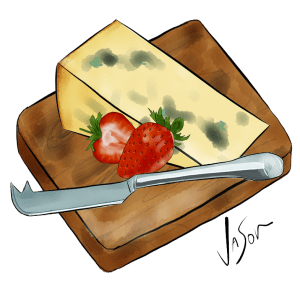
Picture of blue vein cheeseIt’s a fact of life, not everybody likes blue vein cheese. It can be an acquired taste.

Many people I know absolutely hate it. However, when I was kid I can’t recall anybody liking blue vein cheese.

So, obviously there has been a culinary or cultural change in Australia over recent years.

I also think there has been a change in the availability and assortment of blue vein cheese in the marketplace.

If you look back a few decades, there were mainly the very strong, acidic and crumbly varieties available. But now there is a huge range that includes less offensive, mild and creamy versions.

I personally prefer the mild creamy brie style blue veins, rather than the rich Stilton variety.

The history of blue vein cheese isn’t completely documented; however the general consensus is that it was accidental, out of the blue (excuse the pun).

The original product was possibly contaminated with a wild mould, which may have even been dangerous.

However, modern cheese makers have perfected the process of inoculating the cheese with safe penicillin moulds, which after exposure to oxygen turn a shade of blue, and produces a range of pleasant flavours

Blue vein cheese also a very versatile ingredient and can be incorporated into wide range of recipes.

  • The next time you make a creamy cauliflower soup consider adding some blue vein cheese – it’s spectacular.
  • Blue vein cheese also goes wonderful on a gourmet pizza accompanied by prosciutto ham, English spinach and flame grilled capsicum.
  • It’s incredible cooked into a savoury muffin or scone.
  • Try stuffing a chicken breast with blue vein cheese, then crumb and pan-fry.
  • And one of the most fascinating and delicious desserts I’ve tried was pears poached in read wine and served with blue vein cheese ice-cream – it actually was magnificent.
  • Of course, blue vein cheese is also beautiful when simply served on a cheese platter with condiments, such as red wine jelly or quince paste.
Posted in Food and Cooking | Tagged , , , , , | Leave a comment

For Starters

Picture of antipastoThe word antipasto is derived from the Italian ante, which means ‘before’ and pasto which means ‘meal’.
Antipasto is traditionally a selection of hot or cold appetisers served at the beginning of and Italian meal.

The most typical antipasti (plural) items could include various table olives, cheese, pickled vegetables, cured meats, salamis, cold fish, frittata, fresh or sun dried tomatoes and anchovies.

In most of the regional areas of Italy, antipasto will consist of vegetable and meat items, but on the coastal areas you would encounter more seafood, such as marinated calamari or baby octopus.

It is also quite common to find various dips and crispy bread products accompanying the selection, such as crostini, bruschetta or arancini.

Antipasto is  found extensively in the modern restaurant scene, from coffee shops to cellar doors and brasseries all over the world.

It is commonplace to find people of all cultures and nationalities relaxing on a Saturday afternoon at their favourite haunt, sipping wine and sampling the culinary delights of the antipasto platter.

Try some of these ideas

Instalata alla caprese – Slices of vine-ripened tomato, topped with feta cheese, dressed with extra virgin olive oil, fresh basil leaves and ground black pepper.

Giardiniera – A mixture of raw chopped carrots, green beans, cauliflower, capsicum and caper berries, which are marinated in vinegar.

Table olives – marinated in olive oil, garlic and fresh thyme.

Posted in Food and Cooking | Tagged , , , , , , , , | Leave a comment

The Culinary ‘X’ Factor

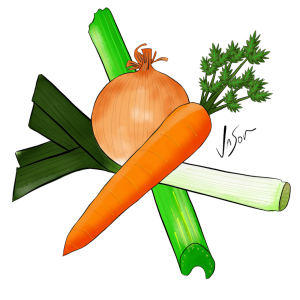
Picture of mirepoixOne of the first skills a professional chef will learn is the production of ‘Mirepoix’.

It’s correctly pronounced ‘meer-pwa’ because the ‘x’ is silent. I can’t help but smile when someone pronounces it ‘miri-pocks’.

Mirepoix is a French term used to describe a mixture of aromatic vegetables which impart their flavour into stocks, sauces, stews or braises.

Vegetables, such as onions, carrots and celery are roughly cut up and slowly cooked into a recipe to improve its flavour. They are often strained out and discarded prior to serving the dish.

However, there is also a myriad of other aromatics that may sometimes find their way into a Mirepoix, such as leeks, garlic, ginger, tomato and mushrooms. Ultimately it’s the desired flavour profile that dictates which aromatic vegetables are chosen.

The cooking time also plays a role in the size of the mirepoix. A smaller cut of mirepoix will impart its flavour faster in a dish that requires shorter cooking time (e.g. braises) and a larger cut is less likely to disintegrate over a longer cooking time (e.g. beef stock).

Also, the colour of the mirepoix is important. A white stock or sauce wouldn’t contain any carrots or dark green celery, whereas brown gravy would.

Mirepoix provides an important depth of flavour to savoury dishes – and I consider it the culinary ‘X’ Factor in any recipe.

Posted in Food and Cooking | Tagged , , , , , , , , , , , | 2 Comments

Mysterious Microwaves

Picture of microwave ovenI don’t like microwave ovens. It’s a hate-hate relationship. Therefore I have no advice for you on the subject.

Regardless of what magical tricks the manufacturer will claim their nuclear gadget can do, I would never use a microwave to cook something.

They do have some limited use, to defrost small frozen food items, or to melt butter (maybe). But even then, they regularly over-heat; burn and half cook the food.

With all the buttons, dials, beeps, bells and digital displays found on a microwave, I believe they only really have two settings – high biff and low biff!

Also, there is one issue that annoys me the most, no two microwaves are ever the same. I have never seen the same microwave in anyone else’s kitchen, like I have in mine.

I have worked in countless restaurants, and have never seen the same model of microwave. I once walked through a roadhouse kitchen, and they had a bank of 8 microwaves, all of which were different brands and models.

Think about it… have you ever seen an identical version of your microwave anywhere else on the planet?

Every time you’ve gone to use someone else’s microwave, you didn’t know how to use it, or know where the start button was located, or how to open the door – did you?

However, I have a theory that solves this baffling mystery. Microwave ovens are manufactured using an automated ‘random’ assembly machine. The parts are shuffled like a deck of cards and then blindfolded robots randomly assemble them, ensuring no two microwaves are ever identical.

There you have it, mystery solved!

Posted in Food and Cooking | Tagged , , , , , , | Leave a comment

Going Bananas

Picture of bananas

Unfortunately for me, I can’t eat raw bananas without upsetting my stomach.

I’m also too unfit to swing from trees – so I would make a lousy monkey. There is something in them (maybe tannin) that makes my feel unwell.

I can however eat cooked bananas, so if you have a similar intolerance, try them barbecued or fried with caramelised sugar and rum. Or maybe diced and cooked in pancakes.

Bananas are one of the oldest cultivated fruits and have been eaten by humans in places like India and Asia thousands of years.

Contrary to popular belief, bananas don’t grow on trees or even palms; they are the fruit from one of the world’s largest herbs. And, to confuse the issue some more, bananas are technically a berry.

Bananas grow in large bunches referred to as a ‘hand’ and are harvested green, because they ripen best after being picked. They contain heaps of essential vitamins (particular B-group), complex carbohydrates, potassium, dietary fiber and absolutely no fat.

Varieties commonly available in Australia are Cavendish, Lady Finger and the new Gold Finger variety.

Banana leaves can also be used to make parcels for steaming fish, and I have also used banana flowers in some Asian stir-fries.

Caramel and Rum Bananas

  1. In a frying pan melt 2 tbsps of butter; add 2 thickly sliced large Cavendish bananas and fry to a light golden brown.
  2. Sprinkle in 2 tbsps of raw caster sugar and continue cooking until sugar thickens to a caramel.
  3. Add 2 tbsps of rum and if using gas stove be careful of a flambé effect –whoosh!
  4. Place the caramel bananas in serving bowls and dollop on a generous scoop of natural yoghurt.
Posted in Food and Cooking | Tagged , , , , , | 3 Comments

The Squash Racket

Picture of squashI’ve discovered over the years that there can be some confusion categorising squash, depending on where you live in the world.

There is a whole range of vegetables that belong to the ‘Marrow’ family. They include squash, melons, cucumbers, gourds, marrows (zucchinis) and pumpkins.

The general rule is that squash that grow in winter time have thick skin and hard flesh, while summer squash has softer skin and wetter flesh.

In Australia, when someone goes shopping for Summer Squash, they are referring to the ‘Pattypan Squash’. Pattypans are flying saucer shaped with knobbly edges and are often available in green or bright yellow (as in my illustrated).

Also, what Australians refer to as Zucchini, Americans may call ‘Courgette’.

Pumpkins can also cause equal confusion for Australians, because in the US many varieties are referred to as squash or gourds.

It seems to me that if an American can carve it into a Jack-o’-lantern, then it’s called a pumpkin?

I’m not certain where the differences in squash terminology originated. It may be possible that America drew culinary influence from France, while Australia was traditionally guided by Britain.

So, regardless of where you reside on this great planet, it pays to be cautious when reading from a foreign recipe book or website and check that you are using the correct type of squash.

Putting all the differences aside, some things still remain similar. Most squash varieties can be boiled, pureed, braised, steamed and sautéed. Squash are colourful, versatile, healthy and delicious.

Posted in Food and Cooking | Tagged , , , , , , , , , , | Leave a comment