Carrot Top

Picture of carrotsCarrots have the unenviable status of being so common; they are often taken for granted.

Which is a pity, as they have wide culinary versatility, great nutritional value, are inexpensive and indispensable in the kitchen.

Did you know there is over one hundred varieties of carrot species?

There is a range of colours available – I personally have cooked with white, yellow, orange, pink, red and purple carrots.

When carrots are pulled from the ground while they are still tiny, they are referred to as baby (or new season) carrots.

Baby carrots are tender, don’t need to be peeled and are wonderful eaten raw in salads – although they are also amazing sautéed in butter.

The larger mature carrots are a little more fibrous and best grated if eaten raw and are usually cooked to make them tender.

As carrots mature they take on a more sweet and savoury flavour profile, and add a depth of flavour and savoury body to stocks, soups, stews or braises.

Carrots can be boiled, steamed, pureed, roasted, fried in tempura batter or simply eaten raw as a snack.

They can also be eaten in deserts, such as carrot cake and muffins.

Carrots are also popular in healthy vegetable juices as they contain high in Vitamin A, Carotene, Vitamin C and antioxidants.

Carrots can be stored in the refrigerator for many weeks, however if they are kept too long they may become limp or start growing roots.

Posted in Food and Cooking | Tagged , , , , , | Leave a comment

Creamy Avocado

Piocture of avocadoThe avocado is listed by ‘Guinness Book of Records’ as the most nutritious fruit on earth.

Avocado is rich in folate, mineral potassium, Vitamins A, B6, C and dietary fibre.

They do not contain cholesterol, as commonly mistaken, although they do contain more fat than any other fruit – yes, they are a fruit.

The natural fat found in avocado is mostly monounsaturated fat, which has the same healthy properties as olive oil.

Fuerte, Hass and Sharwil are the most common varieties found on the market.

With the diversity of varieties cultivated, avocado is available all year round.

They are often purchased unripe, and need to be ripened on the kitchen bench until flesh softens.

Apart from different textures of the skin, ranging from pale green and smooth to dark green and rough, the ripe flesh should always be a creamy butter texture.

In fact you can substitute butter with avocado when making sandwiches.

For an interesting twist on an Aussie favourite, try avocado and Vegemite on toast.

Avocado & Pumpkin Guacamole

  • 150g ripe avocados, mashed
  • 150g jap pumpkin, cooked and mashed
  • 1 lime, juiced
  • 1 chili, finely chopped
  • 1 ripe tomato, finely chopped
  • 1 clove garlic, crushed
  • ¼ red onion, finely chopped
  • 4 sprigs coriander, chopped
  • 30ml extra virgin olive oil
  • salt & pepper, to taste
  • Tabasco sauce, to taste
  1. Combine all ingredients.
  2. Season with salt and pepper; add Tabasco sauce to desired spiciness.
  3. Serves with toasted bread, or sticks of crisp vegetables

Serves 6-8.

More avocado recipes here.

Posted in Food and Cooking | Tagged , , , , , , | 2 Comments

Some Like It Hot

Maybe you like chilli peppers or maybe you don’t?
After all the heat from a chilli can vary from a slight tingle to a thermonuclear detonation.

There are hundreds of varieties of chilli pepper. They vary in size, shape, colour and heat.

Unripe chilli peppers are green and ripe are red, orange, yellow or even black.

Chilli peppers contain a chemical called ‘capsaicin’. It is found in the membrane holding the seeds together and anchoring them within the chilli pod.

The capsaicin binds to a receptor in the lining of the mouth. This is the same receptor that registers pain from heat, thus the effect is a burning feeling – more capsaicin, more pain.

The distressed mouth receptor also causes the brain to release endorphins. The effect is similar to what happens to extreme sports athletes.

Unfortunately it is difficult to tell how hot a chilli is just by looking at it.

Generally small chilli peppers (such as Bird’s Eye) with the seeds in are very hot and large chilli peppers with the seeds removed are milder.

How come some chilli peppers merely tickle your tongue while others blow the roof off your head?

In 1912, a chemist called Dr. Wilbur Scoville investigated this phenomena and developed a chilli heat measurement.

The test, officially called the ‘Scoville Scale’, measures the level of  capsaicin in different varieties of peppers.

The greater the number of Scoville Units (SU) found, the hotter the pepper.

Here’s the chilli heat scale:

Variety Scoville Unit (SU)
Capsicum 0
Cherry Pepper 100-500
New Mexico 500-1,000
Ancho 1,000-1,500
Poblano 1,500-2,500
Jalapeno 2,500-5,000
Chilcostle 5,000-10,000
Cayenne 10,000-30,000
Birds-eye 30,000-50,000
Chiltepin 50,000-80,000
Habanero 80,000-300,000
Pure Capsaicin 16,000,000 (used in tear gas)

The ‘Red Savina’ Habanero has been tested at over 577,000 Scoville units. That is 10 times hotter than the common Birds-eye.

Guinness Book Of World Records lists it as the world’s hottest chilli.

After stupidly consuming this little firecracker, you’re likely to wake up dazed and confused from a two-week coma, aboard a Russian submarine with no recollection of how you got there! 

Easy Spicy Tomato Sauce

  • 400g can chopped tomatoes
  • 100ml sweet chilli sauce
  • Juice of 1 lime
  • 1 tbsp brown sugar
  • 1  long red chilli, seeded, chopped
  1. Combine all the ingredients in a small saucepan.
  2. Bring to a simmer over low heat and cook for 10 minutes until thickened.
  3. Season to taste and cool.
  4. Pulse in a food processor to puree.

Keeps in the refrigerator for up to 1 week.

Posted in Food and Cooking | Tagged , , , , , , , | Leave a comment

Gotta Luv Garlic

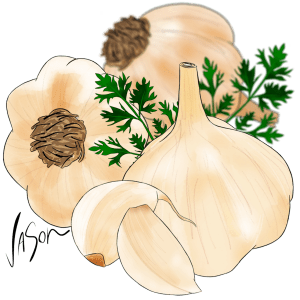
Picture of garlicAn Italian chef once told me that if you eat lots of garlic, you will be more passionate about life.
I have a slightly different theory; people either passionately love garlic or absolutely loathe it.

My father can’t stand it. He gets pretty annoyed if he tastes it in his dinner. Sometime, when he discovers his food contains some garlic, I fear he may burst into flames like a vampire.

My Mother doesn’t care though, and sneaks it in anyway – she loves garlic (and so do I).

Garlic belongs to the same family as onion and leek.

It is a bulbous herb, with a strong flavour.

Each garlic bulb (or head) separates into individual sections called ‘cloves’.

There are many different varieties throughout the world, varying in size, colour and strength.

Garlic has been used for thousands of years, as medicine, and to repel vampires (or my father), but most importantly it can complement the flavour of just about any savoury dish.

Garlic is available all year round, however it’s fresher, firmer and plumper in summer.

Macadamia Nut Pesto

  • 2 fresh garlic cloves
  • 30g macadamia nuts, toasted
  • 10g pine nuts, toasted
  • 50g fresh Greek basil leaves
  • 75g parmesan cheese, grated
  • 100ml extra virgin olive oil
  • 50ml extra virgin macadamia oil
  • salt and pepper
  1. Blend garlic, macadamia nuts, pine nuts, basil and Parmesan cheese to a smooth paste.
  2. Gradually blend in the olive and macadamia oil.
  3. Season to taste with salt and fresh ground pepper.

It will store for a week in the refrigeration. Spread on thick slices of toasted bruschetta.

Posted in Food and Cooking | Tagged , , , , , , | Leave a comment

Sweet As A Pea

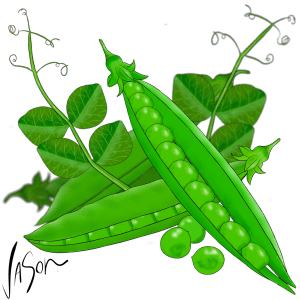
Picture of peasAs a kid, I hated green peas.

Firstly because they where green and secondly because they where a vegetable (although they’re botanically a fruit).

Nowadays I don’t mind them, especially if they are garden fresh.

Peas are a small, spherical seed encased in a green seed-pod. There’s about 6-9 seeds in each pod.

They grow on vine-like shoots which can be grown most of the year but really thrive in the cooler months of Spring.

My wife often pants peas and when they are in season we pick them on a daily bases.

There’s something special about cracking the pods open and eating the fresh peas straight from the garden.

There’s a few different varieties available such as dried split peas which are simmered and used to make soups or a mushy pea mash, Snow Peas and Sugar Snap Peas are a couple of varieties which are eaten fresh, pod-and-all in stir fries or salads.

Petits Pois are normal green peas which are harvested young and tiny, then steamed or boiled as a vegetable.

The immature shoots of the pea plant can be picked while tender and used in Asian stir fries.

I once saw dried peas coated in Wasabi and eaten a snack food (kind of like peanuts).

Peas are also sold frozen or tinned, but I don’t really like them because they aren’t as firm as the freshly harvested peas.

Green Pea Risotto

This is my favourite risotto recipe. Some people find it’s fluorescent green colour a little confronting, however they quickly become fans after their first taste.

  • 25ml olive oil
  • 1 garlic clove, crushed
  • ½ onion, finely diced
  • 200g frozen peas
  • 850ml chicken or vegetable stock, hot
  • 175g aborio rice
  • 100ml dry white wine
  • 25g parmesan, grated
  • salt and pepper
  • 30g pea shoots
  • extra-virgin olive oil, to drizzle
  1.  Fry onion with olive oil in a saucepan until tender, add garlic and cook for 1 more minute.
  2. Meanwhile, puree 100g peas into a food processor with a 100ml stock.
  3. Add rice to the onion, increase heat and sizzle the rice for 1 minute.
  4. Add the wine, then simmer until completely absorbed.
  5. Continue ladles of stock one at a time, allowing it to absorb and stirring continuously until the rice is tender and has a good creamy consistency.
  6. Stir in the puréed peas, and the remaining whole peas.
  7. Add parmesan and season with salt and pepper.
  8. Serve in shallow bowls and top with some pea shoots and a drizzle of olive oil.

Serves 4.

Posted in Food and Cooking | Tagged , , , , , , | Leave a comment

Mean and Green

Picture of KiwifruitKiwifruit may be commonplace nowadays; however when I first started cooking in the mid 1980’s, it was still considered by many people as an exotic fruit.
Kiwifruit has a long and interesting history.

It was originally referred to as ‘Chinese Gooseberry’ or Yang Tao in it’s native country of Northern China. There are also many variant species originating from other Asians countries.

It wasn’t until New Zealand began cultivating and exporting the fruit to countries as the US that it became popular in Western cultures.

It also underwent a market driven re-branding after World War II, to the well-known name of ‘Kiwifruit’, which helped attract Western consumers.

Kiwifruit has a light brown, furry skin that encases a soft, bright green flesh. The centre contains an edible white core surrounded by dozens of tiny black seeds.

Although the skin is edible, most people would either peel the fruit or cut it in half and scoop the flesh out with a spoon.

The flavour of a ripe kiwifruit would be best described as sweet and perfumed, yet slightly acidic.

Kiwifruit flesh is best served raw as an addition to fruit salad, blended into smoothies or pureed and frozen as a sorbet.

It is high in vitamin C, and has a unique enzyme that can help tenderize other ingredients such as squid flesh. I have tenderized calamari rings in fresh kiwifruit puree on many occasions, it works a treat.

 Mean Green Smoothie

I’m pretty much addicted to fruit and a vegetable smoothie these days, and one of my favourites contains kiwi fruit.

Blend together the following chilled ingredients:

  •  2 kiwifruits, peeled and chopped
  • 1 green apple, cored and chopped
  • 2 cups fresh baby spinach leaves
  • 2 tbsps Greek yoghurt
  • ½ cup almond milk
  • 1 tbsp honey
Posted in Food and Cooking | Tagged , , , , , | Leave a comment

Cool As A Cucumber

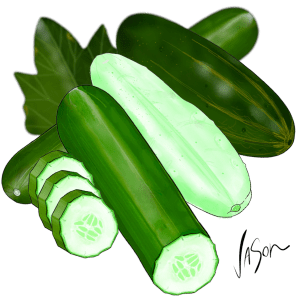
Pictureof cucumbersIt’s not only the most refreshing of all vegetables, cucumber is also one of the first vegetables to be cultivated – in fact it is believed that humans have grown them for several thousand years.

Cucumbers can contain over 90 percent water, giving them their highly refreshing quality.

Although there are more than one hundred varieties cultivated around the world, most
people would only be familiar with the few that are commonly available in their countries.

The two varieties I grew up with where the common smooth, dark green skinned
type with lots of seeds and a jelly-like centre, or the white skinned apple type.

The problem with those varieties is the skin can be tough-as-leather and the often-bitter seeds will send anything else they are served with soggy. They are also believed to cause indigestion.

Nowadays the most popular would be the Continental (or telegraph) variety, the skin is tender and there are considerably less seeds giving them the nickname of ‘burpless cucumber’.

Other smaller cucumbers with very thin skins are grown for pickling, used to make gherkins and dill pickles.

Indians produce a refreshing accompaniment for hot curries called ‘raita’, where the water is remove from the thinly sliced cucumber with salt and then mixed with natural yoghurt.

Cucumber Dip for Anything

Skin, deseed and finely chop one Lebanese cucumber, then combine in a bowl with one garlic clove (crushed), one tablespoon of fresh lemon juice, one tablespoon of fresh chopped mint, one cup of natural yoghurt. Season with salt and pepper.

Refrigerate for three hours before eating.

Gazpacho Soup

  • 2 slices  bread, cut into cubes
  • 2 tablespoons red wine vinegar
  • 1 small garlic clove, crushed
  • ½ teaspoon sugar
  • 4 ripe tomatoes
  • 1 red capsicum, seeded, chopped
  • 1 continental cucumber, seeded and finely chopped (reserve half)
  • ½ long red chili, seeded
  • 3 red onions, chopped
  • ¼ cup olive oil
  • salt and pepper
  1. Place bread, vinegar and garlic into a bowl and leave for 10 minutes.
  2. Transfer the bread into a blender with sugar, tomato, capsicum, cucumber, chili and onions, and then blend until smooth.
  3. With the blender running, pour in olive oil in a thin stream until emulsified.
  4. Season with salt and pepper.
  5. Transfer gazpacho to a large jug, cover and refrigerate until chilled.
  6. Just before serving, stir well with ice cubes and add extra finely chopped cucumber as a garnish.
Posted in Food and Cooking | Tagged , , , , , , | Leave a comment

Off The Cobb

Picture of cornCorn has been eaten by humans for thousands of years.

It was cultivated by the Inca, Mayan and Aztec.

Corn is still a very prominent staple in South and Central America.

In North America, the words ‘corn and maize’ describe a cereal grain cultivated for use in stock feed, corn syrup, grain alcohol (for whiskey), corn starch, corn meal, and even for use in gasoline.

There’s many different species of corn.

It’s usually yellow, but there’s also red, white, orange and blue.

There is also an heirloom variety called ‘Glass Gem’, which is made up of vibrant, randomly coloured, translucent kernels that actually look like they are made of glass. They need to be seen to be believed.

However, in my home country of Australia most people would think of the yellow ‘sweet corn’ that we eat fresh from the cob, or as the kernels that can be purchased in cans.

Sweet corn is a variety that is high in sugar. It’s a species that has naturally formed through recessive mutation. In a way, it’s like picking maize immaturely, before the sugars can convert to starch.

Maze is picked after it’s dried out, but sweet corn is harvested while it’s still juicy.

Therefore, sweet corn is eaten as a vegetable soon after picking, because it has a short shelf life.

Make sure you buy the freshest available (preferably with the husk still on).

Corn can be microwaved (husk on) at high power for approximately 3 minutes and then smeared with butter to serve.

Or, it can be barbecues in the husk for a smoky flavour.

Corn and Tomato Salsa

  1. In a pot of boiling salted water place 6 Roma tomatoes. Leave for 30 seconds and then remove, peel and chop the flesh.
  2. On a barbeque, grill 4 lightly oiled cobs of corn for approximately 5 minutes or until fully cooked and tender.
  3. After the corn has cooled, slice off the kernels and mix with the tomato flesh.
  4. Add 1 finely chopped red onion, 1 finely chopped green capsicum and 1 finely chopped red chilli.
  5. And finally, add 1 tablespoon of chopped fresh coriander (no seeds) and the juice of 2 limes.

Serve as a dip with corn chips.

Posted in Food and Cooking | Tagged , , , , , | Leave a comment

Capsicums or Peppers?

Picture of capsicumsAs an Australian, I personally don’t feel comfortable with ‘Capsicums’ being referred to as ‘Peppers’, its un-Australian by Crikey!
However, it’s completely normal to call them bell peppers (or just peppers) in many other countries.

Christopher Columbus purposefully misnamed the small chilli variety as pepper, so he could sell it as a cheap alternative to the expensive spice (peppercorns).

Nevertheless, if you read an American recipe book, asking for bell peppers or a UK cookbook asking for red peppers –they are referring to capsicum.

The capsicum is actually a fruit, but it is generally used as a vegetable (though, I once ate sweet capsicum sorbet).

The shapes vary considerably, from rounded like tomatoes, to long banana shaped or the more common box shaped.

There is also a rainbow of colours – green, yellow, orange, red, purple and almost black.

Most capsicum starts green and change to their various colours as they ripen. Capsicums can be eaten fresh in salads, as crudités, stuffed and baked, in stir-fries, in soups (like Spanish gazpacho), cooked into a sweet conserve or roasted.

Roast Capsicum

Although this has been produced in te Mediterranean for centuries, it has become very popular in Western countries, often used on antipasto platters, in salads or on pizzas. I love it, because the roasting method sweetens the flesh and provides a smoky aroma.

  1. Smear a capsicum (usually red) with Extra Virgin Olive Oil.
  2. Place in a hot oven at 210 degree for 20-30 minutes.
  3. Turn the capsicum occasionally to get even blistering of the outer skin.
  4. Immediately on removal from the oven, wrap the capsicum in glad wrap, which sweats off the skin.
  5. When cool, peel off and discard the skin – do not wash the flesh under water or you will loose precious flavour.
  6. Store in fridge for up to a week.

A similar effect can be achieved on the grill bars of a barbeque, producing a smoky flavoured flesh.

Posted in Food and Cooking | Tagged , , , , , | Leave a comment

The Accidental Tomato

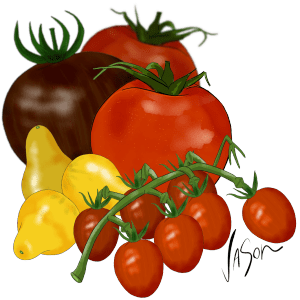
Picture of TomatoesAs much as I’d like to think of myself as a green-thumb, the truth is I’m not.

My latest tomato vine grew randomly out of some chicken manure I used as fertilizer.

With no TLC whatsoever, the vine produced the most exquisite tomatoes I’ve very seen.

Nevertheless, I would like to deliberately plant some more tomato varieties and learn how to grow them properly.

Did you know the tomato has been called everything from the Moor’s Apple, to the Wolf Peach, to the Love Apple?

Tomatoes originated in South America and were taken to Europe by explorers in the 16th century.

Who knows what Italian, Spanish and Greek dinner tables would have looked like before that?

Although most people think tomatoes are a vegetable, they are in fact a fruit. In the last few centuries many varieties have been developed.

Some of the varieties available commercially are Roma, Gourmet, Cherry, Yellow Pear, Beefsteak and Standard Round.

Obviously, my favourite is the hand-picked vine-ripened variety, (just like my accidental tomatoes) they are the best tasting and far better than the mechanically harvested and cold room ripened.

Semi-dried Roma Tomatoes

Semi-drying is a fantastic process for preserving and intensifying the flavour of ripe, red tomatoes. Good quality Roma tomatoes are best for this recipe. They are delicious used on antipasto platters, in pasta dishes or on pizza.

  1. Heat an oven to 140oC.
  2. Cut ripe Roma tomatoes in half lengthwise and arrange the halves on a wire rack, placed on top of a baking tray. Make sure the cut side of the tomato halves are facing upward.
  3. Sprinkle the tomatoes with sea salt flakes and freshly milled black pepper. You can also season them with fresh chopped herbs, such as parsley, basil, oregano or thyme.
  4. Bake in the oven for several hours or until the tomatoes shrivel around the edges, but remain soft and fleshy in the middle. Remove from the oven and allow them to cool.
  5. Place the semi-dried tomatoes in a sealed container and cover with extra virgin olive oil. The oil helps shield the tomatoes from oxygen and increases shelf life.

These tomatoes can last at least a month in the refrigerator.

Posted in Food and Cooking | Tagged , , , , , , | 1 Comment