
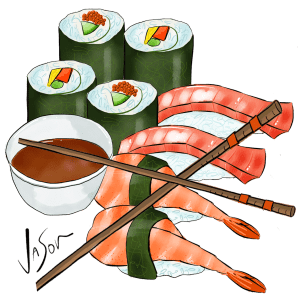
 My love affair with Sushi began in the mid 90s when I worked as a Pastry Chef in a large hotel. One of the hotels restaurants was a Japanese Teppanyaki style dining room.
I would smuggle the Japanese Sushi Chef’s desserts as a trade for their sushi and tempura. I became hopelessly addicted.
Eventually, my obsession became so overwhelming, I convinced the Sushi Chefs to show me how they were made, so I could make them myself at home. I quickly discovered that with practice I could make all kinds of varieties..
And, although I love the raw seafood variety, you can really put anything you desire on, or in sushi. Cooked chicken, tuna, seafood sticks, avocado, vegetables, noodles… anything!
Japanese cuisine has become very popular in today’s western culture, though it is often adapted to more western tastes. Sushi used to be the exclusive delicacy of powerful Japanese Emperors, now you can find it sold on any street corner, pub, club, in most shopping mall food courts and airport cafes.
However, like me, many sushi addicts are not just content to go out for their sushi fix; their craving is driving them to manufacture it in their own homes.
There’s also dozens of books on the subject, I once went to a local bookstore to buy a book on sushi, and left with five (cookbooks are my other addiction).
So, if you’ve never eaten sushi, give it a try, it doesn’t have to contain raw seafood. I’m sure there are flavours out there that you would love. You may also get hooked.
What types of sushi are there?
Finger sushi – a delicate layer of raw or cooked seafood, smeared with Japanese horseradish (wasabi) and resting on a pillow of rice
Box sushi – a bed of rice, a smear of wasabi and a seafood topping is pressed in a wooden box and then cut into bite-sized pieces
Rolled sushi – the most simple, Japanese rice and various fillings rolled up in a sheet of seaweed.
Hand rolled – rice and various fillings of meat, seafood and vegetables rolled in seaweed sheets shaped like an ice-cream cone
Sushi goes great with dry, sharp citrus white wines, sake or Japanese style green tea.
 Although strawberries appear to be at their best and cheapest in summer, they are available all year round.
 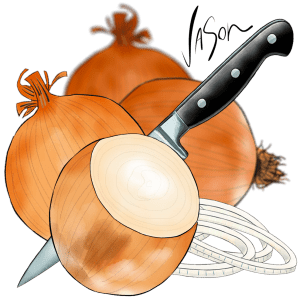 It’s one of the most humble and least glamorous vegetables on Earth; however most cuisines would be unrecognisable without them.
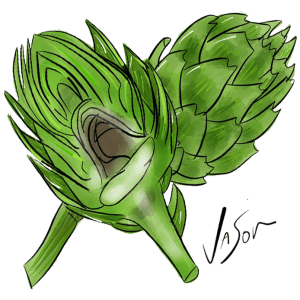 There are three varieties of artichoke – the Globe, the Jerusalem and the Chinese artichoke.
 Asparagus stalks are the young spear-shaped shoots obtained from a perennial plant native to both Europe and Western Asia.
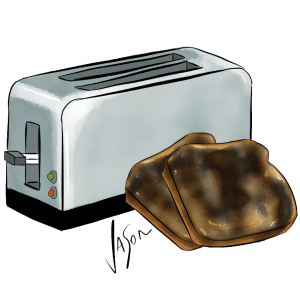 Cooking is a process of applying heat to a food item to increase palatability, to enhance flavour, tenderise, caramalise and even kill off bacteria.
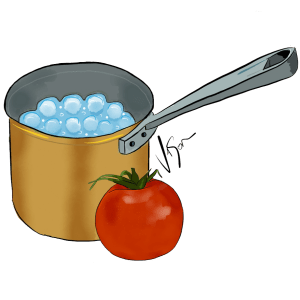 Now you may ask, “Why would you want to peel a tomato”?
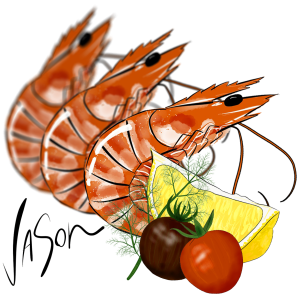 I’ve discovered over the years there are just as many people claiming to be allergic to prawns, as those who can’t eat enough of them.







 Ford on Food
You must be logged in to post a comment.