
Recipe for Success

Picture of recipesOne of the most important aspects of cooking is the recipe. Following a recipe is critical to culinary success.

Contrary to popular belief, qualified Chef’s always follow recipes regardless of their experience. It’s a chef’s responsibility to provide a consistent product to their guests, irrespective of how they feel or what day of the week it is.

However, many amateur cooks lack recipe literacy.

To start with, the most important part of the recipe is not the ingredients – it’s the step-by-step method that matters most.

Let’s face it, sometimes a recipe works out fine, even if one of the ingredients is missing. However, if you miss one step in the cooking instructions, it’s a recipe for disaster.

Another critical factor to a recipe is the yield (number of portions). If a recipe doesn’t contain information on how many portions it produces, you’re already doomed. Imagine a chef catering for 300 people, and he doesn’t know how much to multiply the recipe by, because he doesn’t know the recipe’s yield. In this scenario the chef may end up short of portions,  customers will go hungry and are likely to organise a mutiny.

A good recipe will always have consistent units of measurement. If one ingredient is measured in cups and spoons, then the remaining ingredients should as well (although I’m a little guilty of breaking this rule).

It’s my opinion that all ingredients should be listed in the user-friendly metric system of grams (g) or millilitres (ml). And, electronic scales are far more accurate for measuring than spoons and ‘guess-timation’.

I also recommend that you read a recipe from beginning to end before you commence, as there may be some vital information overlooked, such as pre-heating an oven or pre-soaking an ingredient in water overnight.

Also, don’t expect a recipe to look exactly like the picture; there are at least three specialists involved in the process of making a glossy food photograph.

Never fear, true culinary success is judged by good flavour – not by perfect presentation.

For some of my favourite recipes, click here.

Posted in Food and Cooking | Tagged , , , , , , | Leave a comment

Eat Your Greens

Picture of vegetablesMark Twain, the Author of ‘Tom Sawyer’ is quoted as saying, “Cauliflower is nothing, but cabbage with a college education.”

Maybe he meant that cauliflower was cabbage disguised as something of beauty and refinement – or he was calling cabbage just plain dumb? None-the-less, I don’t think either vegetable deserved such an unprovoked attack.

In ‘Charlie and the Chocolate Factory’ Roald Dahl writes that the Bucket family were so poor that every day they ate boiled potatoes and cabbage for lunch and cabbage soup for supper. Charlie would only break this tedium with a bar of chocolate on his birthday.

I know the repetitiveness of eating that menu every day would be unbearable, but what’s with this relentless literary slander?

Anyone would get the impression that green vegetables are in some way inferior.

PJ O’Rourke also wrote offensive comments about vegetables in his book ‘The Bachelor Home Companion: A Practical Guide to Keeping House Like a Pig’. He wrote that most vegetables are something God invented to help women take revenge on their children.

He also stated that a fruit is a vegetable with good looks and money.

Plus, if you let fruit rot, it turns into wine, something Brussel sprouts never do. It can’t do much for a Brussel sprout’s self-esteem and confidence.

I’d suggest green vegetables have grounds for a class-action defamation lawsuit.

A recent study has discovered that the reason why so many children don’t like vegetables is genetic. There is a certain gene that causes most kids to be over-sensitive to bitter flavours.

Because my wife and I are both chefs and avid foodies, our children were born with a severe green vegetable eating disability (kind of a genetic mutation).

Unfortunately, if it’s green – they run for the hills screaming blue murder. But, I’m sure many parents can relate to that!

But the truth is that vegetables contain much of the essential nutrition to sustain a healthy lifestyle. And, with a little bit of thought, they can be cooked into a delicious meal. In other words, they will give back 10 times more love to you as the effort you put into them.

In modern society, vegetables are often abused and undervalued; I believe they deserve a lot more respect.

Posted in Food and Cooking | Tagged , , , , , | Leave a comment

Bring Home The Bacon

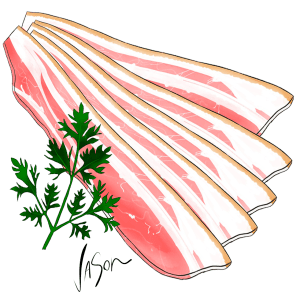
Picture of baconBacon is the main reason why I’ve never become a vegetarian.

I think bacon is one of the most extraordinarily delicious foods known to humankind.

Although I’d agree that bacon does go with just about everything, I wouldn’t recommend eating it to excess as it contains a large amount of sodium and fat.

Bacon is made from various cuts of pork (generally the belly) which is cured in a liquid brine or dry salt packed. Then it is commonly infused and showered with liquid smoke and baked.

The more traditional bacon is cooked in a smoking oven or boiled.

Bacon is often firmed up by refrigeration for various periods of time, so it can be thinly sliced into rashers before packaging.

Mass produced bacon is often heavily processed and contains considerable amounts of artificial flavourings and preservatives. such as sodium nitrite.

For a more traditional and less processed version of bacon it pays to know your local butcher, many of which will produce their own home-made bacon.

There are also many boutique smokehouses that specialise in niche charcuterie products, such as richly double or triple smoked bacon. Some of the best smoked bacon rashers I’ve had was butcher shop produced bacon by the local butcher.

Typically, the consumer will cook the bacon rashes before eating it. It can be fried, grilled, baked or boiled and can adds a delicious savoury flavour profile when used as an ingredient in recipes, such as soups.

So if you’re not a vegetarian, see what your local butcher has on offer and bring home the bacon.

Easy Carbonara

  • 500g pasta
  • 100g chopped ham
  • 2 egg yolks
  • 2 tbsp cream
  • 2 garlic cloves, minced
  • ½ cup Parmesan cheese, grated
  1.  Cook the ham in a fry pan until crisp. Remove from pan and drain on paper towels. Set the ham aside.
  2. Cook the pasta as directed on package.
  3. Meanwhile, combine the egg yolks, cream, and garlic in a medium bowl and beat until well blended.
  4. When the pasta is cooked, drain and immediately return to the pot.
  5. Stir in the egg mixture and toss thoroughly until combined.
  6. Add the bacon and cheese and toss again to coat. Season if required.

Serves 4.

Posted in Food and Cooking | Tagged , , , , , | Comments Off on Bring Home The Bacon

Imaginary Chefs

Picture of Chef CharactersCelebrity chefs are a very common part of today’s pop culture.

Ironically, most of my chef idols aren’t even real. I’m a huge fan of fictional chef characters.

Even before I worked in a kitchen, I was a devotee of the ‘Swedish Chef’ who appeared on the Muppet Show.

No matter how brutally he was treated by his ingredients; the Swedish Chef would always put up a courageous fight.

As a kid, I thought that all chefs spoke with his accent. “de umn bork! bork!bork!”. Surprisingly once I became a chef, I discovered that many did.

In the 1970’s my Parents bought me a Smurf Chef figurine from a service station – smurfs were all-the-rage. The other day my daughter was watching the new Smurf movie and I noticed that Smurf Chef has now become an important character… go Smurf Chef!

Not everyone is familiar with the animated TV show ‘South Park’, but there was a wonderful (somewhat politically incorrect) character name ‘Chef’ who worked in the school cafeteria. He was voiced by the magnificent soul singer Isaac Hayes, and was a much loved mentor to the kids of South Park.

In The Simpsons, the local Italian restaurant owner ‘Chef Luigi’ often entertains Springfield’s corrupt Mayor Quimby and mob boss ‘Fat Tony, serving up bowls of his popular spaghetti and meat balls. I often fantasise about dining in Luigi’s restaurant.

And, my favourite imaginary chefs of all time are in the PIXAR animated movie Ratatouille. I’ve watched it dozens of times and firmly believe in the movie’s simple message, “anyone can cook”.

Posted in Food and Cooking | Tagged , , , , , , , , | Leave a comment

Spilt Milk


Picture of milkI have a love/hate relationship with milk.

I love to use it in cooking. But personally, I hate the bloated feeling I get after drinking it.

So I’ve now turned to soy milk and almond milk, which seems better (for me anyway). And I also drink my coffee black as a straight shot of espresso.

As a chef I would be lost without milk, as it’s an essential ingredient in many of my favourite recipes.

However, for some time I’ve been questioning whether humans should be consuming something that is really meant for calves, baby goats and lambs.

In fact, humans are the only species on Earth that consume milk past infancy. Maybe we are not really supposed to be drinking it into adulthood?

But on the flip side, I don’t think I could live without some of my favourite cheeses, which don’t seem to have any effect on me.

So, while I battle with my own hypocrisies, here are some facts about milk:

  • Obviously, milk is a white liquid produced by female mammals, which provides nutrition to newborns.
  • In western countries the most common milk consumed by humans is sourced from cows.
  • Milk is considered a very rich source of nutrients and the highest source of calcium.
  • Not all milk is supplied from cows – people drink milk from goats, sheep, camels, buffalo, yaks and donkeys.
  • I once saw a documentary were Mongolians were milking horses, and churning it into a kind of fermented booze. I even heard that zebra milk is consumed in parts of Africa. Reindeer are also a source of milk – maybe Santa actually has a reindeer milk moustache?

Fluffy Ambrosia Milk

  1. Blend together 140g peaches in natural  juice, 1 tablespoon fresh passionfruit pulp, 2 tablespoons coconut milk, 1 cup of skim milk, 1 cup of apricot nectar, 1 scoop of fat reduced vanilla ice-cream and a couple of ice cubes.
  2. When it’s thick and frothy, pour it into chilled glasses and lightly sprinkle with some toasted desiccated coconut.
Posted in Food and Cooking | Tagged , , , , , | 2 Comments

Tarty Lemon

Picture of LemonsI always find it funny to see a child try a lemon for the first time.

Their face puckers-up like they’re about to implode.

Lemons are an oval, bright yellow fruit and a member of the citrus family.

They are packed with vitamin C and are great for fighting off scurvy on those long voyages to distant lands.  In fact, in the early 1800’s the British Navy spiked their sailor’s rum rations with lemon or lime juice.

The most common varieties available today (yes there is more than one), are Lisbon, Eureka and Meyer. These varieties differ in skin thickness and texture, size, amount of seeds and juice.

Lemons are not often eaten alone; they are generally used as an ingredient in other dishes.

The juice can be used like a dressing or as a replacement for vinegar.

Because of its high citric acid content, lemon juice is also used to stop fruits like apples, bananas and avocados from oxidizing and turning brown.

The waxy zest can also be used to flavour cakes and pastries, or candied and used as garnish.

Lemon and Chive Dressing

Whisk together half a cup of extra virgin olive oil, the juice of one large lemon, a tablespoon of French mustard and a tablespoon of freshly chopped onion chives.

This dressing is superb poured over warm barbecued vegetables like corn on the cob, zucchini, boiled sliced potatoes and large field mushrooms.

It could also be basted over grilled barramundi, whiting or red emperor.  A dressing like this would also be great in a mixed green salad.

It will also keep for weeks in the refrigerator.

Posted in Food and Cooking | Tagged , , , , , | 5 Comments

Plum Crazy

Picture of plumsA plum is a type of ‘Drupe Fruit’, which means they have a leathery skin, surrounding soft flesh which is attached to a hard stone (pit).

Therefore, it falls into the same category as peach, apricot, cherries and nectarines.

Depending on who you talk to, some may claim there are thousands of plum species.

I personally find that hard to believe – I’ve seen many different types in my cooking career, and I reckon there are probably only several dozen varieties.

They all have smooth skin, unlike the furry skin found on a peach and are available in a myriad of colours, such as yellow, red, green, purple and multicoloured skin.

I’ve cut into some that have a loose detached stone and others with a firmly attached stone.

Some plums have yellow, orange or red flesh, while some taste tart and others taste sweetly perfumed.

Most are round and a few are egg shaped.

They can be eaten fresh, cooked into savoury dishes or preserved in jams.

Expect to see plums to land on grocery store shelves in late February and availability to go plum crazy as we near autumn.

If you ever see a white dusty bloom on the skin of a plum, don’t be concerned, this is a natural wax they produce in maturity to protect themselves from the elements.

And… do you want to know something really crazy? Prunes are dried plums.

Posted in Food and Cooking | Tagged , , , , , | Leave a comment

The Heat Is On – Part 2

Picture of chef with steak and thermometerAs promised in last week’s article, here is a brief cooking temperature guide.

Of course there are many exceptions to the rule, but if you stick to the basic temperatures below (and cross your fingers) you can’t go wrong.

Grilling steaks: Grill on a high heat with an audible sizzle as soon as the steak hits the cooking surface.

The core temperature for a Rare steak should be 60oC at most, Medium 70oC and a Well-done steak should be 75oC. And, as I’ve said before there really is no such thing as Medium-well.

Roasting beef or lamb: Roast at 170oC-180oC. The internal temperature for Rare is 60oC, Medium 70oC and Well-done should be 75oC.

Roasting pork: Pork is best cooked gently between 170oC and 180oC. You’ll definitely want your pork to be over 75oC to make sure it is well-done, but don’t overdo it or the meat will dry out.

Roasting chicken: Heat your oven to 180oC. Chicken needs to be thoroughly cooked to 85oC.

Cooking in liquids: Boiling takes place at 100oC, simmering 95oC-98oC and poaching happens at 93oC-95oc.

Baking cakes, pastries and bread: A slow oven is 120oC, a moderate oven is 180oC and a hot oven is 220oC.

Meringues need to be dried out slowly, so bake between 100oC and 120o – the bigger the meringue, the lower the temperature.

Short crust or short bread is best baked at 150oC-160oC.

Sponge cakes should be baked at 180oC .

Bread is baked on a high temperature between 200oC and 220oC.

Posted in Food and Cooking | Tagged , , , , , , , , , | Leave a comment

The Heat Is On – Part 1

Picture of thermometersCooking is a process of applying heat to a food item.

But, what temperature should you use?

This is a very hard question to answer, because of the infinite variables experienced during cooking.

However, here are some brief rules to help guide you to cooking success:

  •  To start with, most countries use the temperature scale of Celsius (symbol oC). A few countries, such as the United States still use the Fahrenheit scale (symbol oF), which is vastly different. Be careful when following recipes from an overseas recipe as you may need to convert it.
  • In my experience, all ovens and stove tops react differently and can’t be trusted until you get to know them. Something that cooks perfectly in your own oven, may burn very quickly in someone else’s.
  • Don’t depend on cooking timers. It’s better to rely on your senses. As food simmers, keep an eye on how rapidly it’s rolling in the pot and adjust the temperature accordingly. As pastry bakes, keep visually checking it for colour, and smell for its baked aroma. As meat roasts, check it by touch and feel how firm it is. And, as a steak grills listen for a noticeable sizzle.

In next week’s column I will share with you a simple cooking temperature guide for roasting, grilling, boiling and baking.

Posted in Food and Cooking | Tagged , , , , , , | Leave a comment

The Good Egg

Picture of eggs

Eggs are one of the most inexpensive, versatile and nutritious foods; with the greatest packaging, nature has to offer. 

They are indispensable in the kitchen.

Hen eggs are graded into different size categories based on their weight.

The largest eggs weigh over 70g and smallest weighing less than 45g. Standard recipes universally use a ‘Large’ egg, weighing approx 55 grams.

Always use the size of egg  recommended by the recipe.

Eggs are best used at room temperature as the do not whisk well or the shells crack when you boil them.

Never wash eggs unless you are about to use them immediately or their protective coating will be lost and they will deteriorate quickly.

Eggs are best stored in the carton they are purchased, and be kept away from strong odours, such as seafood or garlic.

To tell if an egg is fresh, it should have a well-rounded yolk, in the centre of a plump gelatinous white. There should be very little runny white.

Alternatives to hen eggs are Duck, Quail, Goose or Bantam eggs.

Cashew Biscotti

75g          Egg Whites

125g        Caster Sugar

125g        Plain Flour

125g         Raw Cashew Nuts

  1. Warm egg whites and sugar in a glass bowl over simmering water, constantly stirring, until sugar is dissolved.
  2. Place in a mixing machine and whip until firm peaks form.
  3. Carefully fold in the flour and cashews.
  4. Place the mixture in a greased loaf tin and bake at 180oC for 30 minutes.
  5. Remove from oven and cool loaf.
  6. Cut 4mm thick slices and dry them out flat side down on a tray at 150oC until crisp.
Posted in Food and Cooking | Tagged , , , , , | Leave a comment